
Growing a property portfolio in Australia in late 2026?
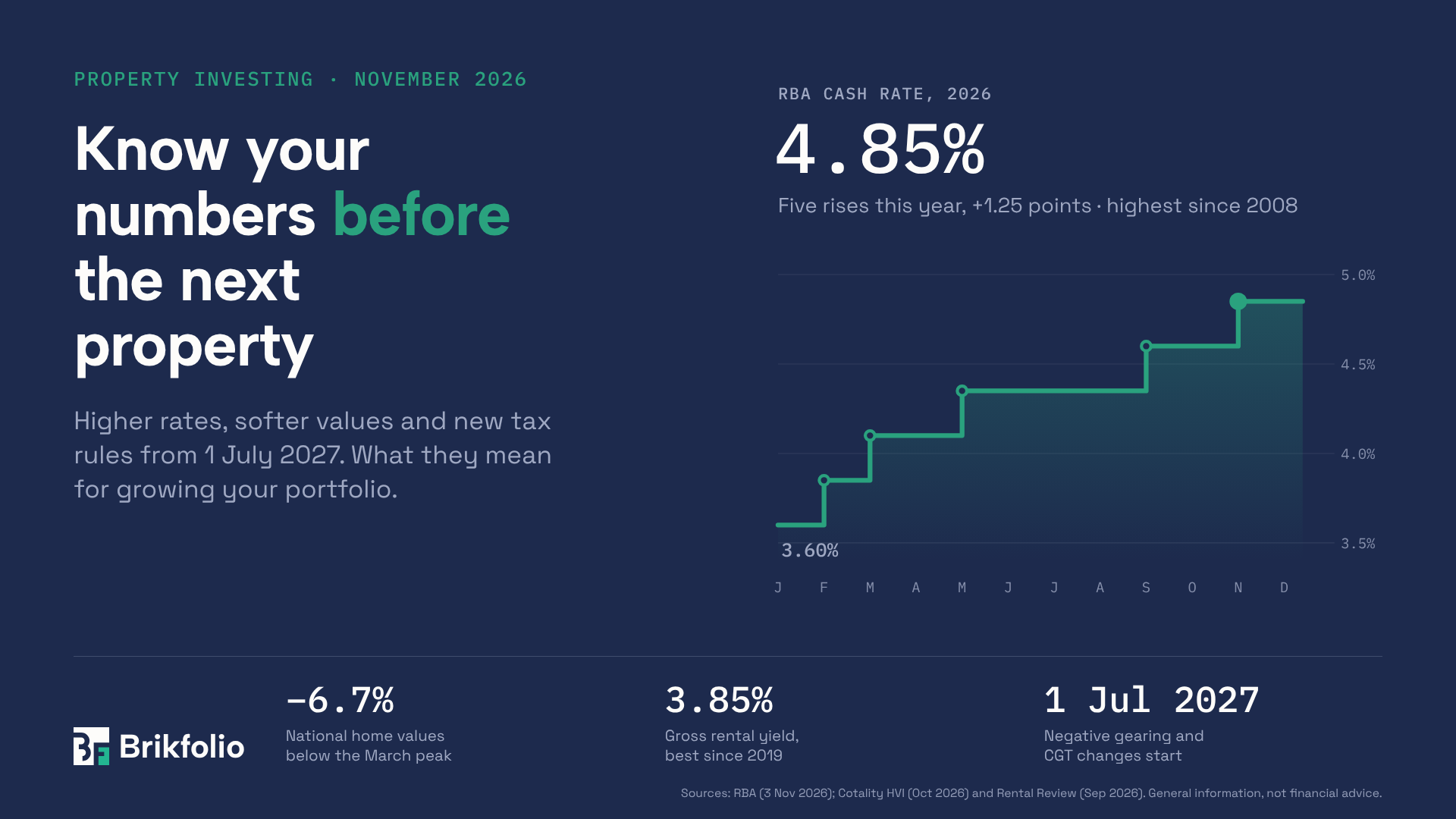
Growing a portfolio in late 2026 is a numbers game, not a market-timing game. Rates are at an 18-year high, values have fallen for seven months, and the biggest tax change for investors in decades starts on 1 July 2027.
That mix rewards investors who know their numbers property by property. It punishes those who run their portfolio from memory and a spreadsheet. This guide covers the data, a worked financial analysis, the new tax scenarios, and the challenges that stop most investors from buying their next property.
All figures for individual properties and investors in this article are fictional examples, labelled as such. They are not advice. Talk to your accountant, broker or financial adviser before you act.
The market in numbers
The short version: borrowing costs are up, values are down, and rents are still rising, but more slowly. Gross yields have improved, yet most new purchases still cost money to hold each week.
| Indicator | Latest figure | What it means for investors | Source |
|---|---|---|---|
| RBA cash rate | 4.85% (raised 3 Nov 2026; fifth rise of 2026; +1.25% this year) | Variable investor loans cost more. The next decision is 8 December. | RBA via Savings.com.au |
| New investor loan rates | Mid-to-high 6% range (before the November rise) | Interest is now the largest holding cost on most leveraged properties. | Cotality |
| National home values | Down 1.2% in October; seven straight monthly falls; 6.7% below the March peak | Equity is shrinking. LVRs rise even when debt stays the same. | Cotality HVI |
| Selling conditions | Median 39 days on market; 4.7% vendor discount; capital-city clearance rates under 50% | A buyer’s market. Selling to fund the next purchase takes longer and nets less. | Cotality HVI |
| Rents | +0.5% in the September quarter; +5.5% over the year; median $713/week | Rent growth is slowing as tenants hit an affordability ceiling. | Cotality Rental Review |
| Vacancy | 2.1% nationally in September, highest since January 2025 | Still tight, but plan for longer gaps between tenants. | Cotality Rental Review |
| Gross rental yield | 3.85% nationally (Sydney 3.40%, Darwin 6.52%) | Best since 2019, but still below most investor loan rates. | Cotality Rental Review |
| Lending rules | 3% serviceability buffer; banks capped at 20% of new loans at 6× income or more (since 1 Feb 2026) | Multi-property investors hit borrowing limits sooner. | APRA |
The gap between yield and loan rate is the key number. A 3.85% gross yield, before costs, against a loan rate near 7% means most leveraged purchases are negatively geared from day one. That makes cash flow, and the tax treatment of losses, central to every decision.
Property financial analysis: one property, five numbers
Five numbers tell you whether a property helps or hurts your next move: gross yield, net yield, cash flow, break-even rate and LVR. Here they are for one fictional property.
Fictional example: an established house bought for $750,000, rented at $650 a week, with an 80% interest-only loan of $600,000 at 7.0%. Costs are typical but illustrative; yours will differ by state, council and property type.
| Line (per year) | Amount | Note |
|---|---|---|
| Rent at $650/week | $33,800 | Full year, no vacancy |
| Less 2 weeks’ vacancy | –$1,300 | Vacancy is now 2.1% nationally |
| Rent collected | $32,500 | |
| Property management (7%) | –$2,275 | |
| Council and water rates | –$3,200 | |
| Landlord insurance | –$2,000 | |
| Repairs and maintenance | –$2,500 | |
| Land tax | –$1,500 | Varies widely by state and landholding |
| Net operating income | $21,025 | Before interest |
| Interest ($600,000 × 7.0%) | –$42,000 | Interest-only |
| Cash flow before tax | –$20,975 | About –$403 a week |
| Depreciation (from a quantity surveyor’s schedule) | –$6,000 | A tax deduction, not a cash cost |
| Rental result for tax | –$26,975 | A rental loss |
What the five numbers say:
- Gross yield 4.5% ($33,800 ÷ $750,000). Looks fine on a listing, but it ignores costs.
- Net yield 2.8% ($21,025 ÷ $750,000). This is what the property earns before debt.
- Cash flow –$403 a week. You fund this from salary or savings every week you hold.
- Break-even rate 3.5% ($21,025 ÷ $600,000). Above this loan rate, the property costs you money. At 7.0%, you are 3.5 points above it.
- LVR 80% at purchase, about 86% after a 6.7% fall in value. Same debt, less equity. That equity is often what funds the next deposit.
Stress test it. Add 1% to the loan rate and interest rises by $6,000. Cash flow falls to –$26,975, about –$519 a week. The 2026 rate rises added 1.25% on their own. If a single 1% move would strain your budget, the next purchase should wait.
One property is easy to do by hand. Three or four, each with its own loan, offset, rent and costs, is where spreadsheets start to break and decisions get made on gut feel.
Tax scenarios: same property, three different outcomes
From 1 July 2027, when you bought and what you bought can change the weekly cost of the same property by about $200. The negative gearing and CGT changes from the 2026–27 Budget are now law.
What changes for negative gearing. Rental losses on established residential property bought after 7:30 pm AEST on 12 May 2026 can no longer reduce tax on salary from 1 July 2027. They can only offset other residential property income and residential property capital gains. Unused losses carry forward. Eligible new builds keep full negative gearing, and properties bought before Budget night keep the old treatment.
Applied to the fictional property above (rental loss $26,975; cash flow –$20,975; investor on a 37% marginal rate plus 2% Medicare levy):
| Scenario (fictional, from 2027–28) | Tax effect of the loss | Cash cost after tax, per year | Per week |
|---|---|---|---|
| A. Established property bought before 7:30 pm, 12 May 2026 | Offsets salary: about $10,520 less tax | $10,455 | about $201 |
| B. Established property bought after that time | Quarantined: no saving this year, loss carried forward | $20,975 | about $403 |
| C. Eligible new build, bought any time | Offsets salary, as in A | About $10,455, often less: new builds usually carry higher depreciation | about $201 or less |
Scenario B is not a lost deduction. It is a delayed one. A quarantined loss can still offset rent from a positively geared property in the same portfolio, or a future residential capital gain. So portfolio mix now matters: a high-yield property can soak up losses from a growth property.
What changes for CGT. For individuals, trusts and partnerships, the 50% CGT discount is replaced by cost-base indexation, with a 30% minimum tax on the real gain. It applies only to gains that accrue from 1 July 2027. Gains made before then keep the old treatment, so a sale after that date splits the gain in two. Buyers of new builds can choose the old discount or the new method.
Three practical points for investors:
- You do not need to sell before 30 June 2027 to keep the discount on gains already made. The transition rules protect them.
- Records matter more than ever. Cost base, purchase date, capital works and the property’s value around 1 July 2027 may all be needed to split a future gain. Ask your accountant whether a valuation is worth getting.
- Model the hold, not just the buy. Under quarantining, a property’s after-tax cost depends on the rest of your portfolio, not just its own numbers.
Tax rules here are summarised for general information. The detail depends on your structure, dates and income. Confirm your position with a registered tax agent.
Common challenges to growing a portfolio
Most investors stall at one or two properties. It is rarely for lack of ambition. It is usually one of these seven walls.
1. Serviceability, not deposit, is the real limit. Lenders test your loans at about 3 points above the actual rate. Since February 2026, banks can write only 20% of new loans at six times income or more, and that ratio counts all your existing debt. Commentary: each property adds debt faster than it adds assessable income, so the wall arrives sooner than most expect. Reducing other debts, lifting rent, or choosing higher-yield stock can buy room.
2. Negative cash flow compounds across properties. One property costing $400 a week is manageable. Three can cost more than a mortgage on your own home. Cotality notes that even with better yields, a neutral-cash-flow purchase is now hard to find. Commentary: know your total weekly shortfall and how many months your cash buffer covers before you add to it.
3. Rate rises arrive faster than rent rises. The cash rate rose 1.25% in 2026. Rents rose 0.5% last quarter. Commentary: the gap lands in your cash flow first. Test your portfolio at today’s rate plus 1% and plus 2%, and know when fixed rates expire.
4. Falling values lock up equity. Many investors fund the next deposit from equity in the last one. With values 6.7% below the March peak, that equity has shrunk, and valuations for refinancing come in lower. Commentary: use a current valuation, not your purchase price or last year’s figure, when you plan the next step.
5. Tax rules have changed under your feet. Quarantined losses and indexed CGT change the maths for every established property bought after 12 May 2026. Commentary: the right next purchase now depends on what you already own. A strategy that worked in 2020 may not work in 2027.
6. Records are scattered. Settlement statements, loan statements, depreciation schedules and agent statements sit in different inboxes. Commentary: missing records cost money at tax time, and under the new CGT rules a weak cost-base record can cost more at sale. Fix it now, not when you sell.
7. Decisions are made on gut feel. Refinance, hold, sell or buy: each is a trade-off between cash flow, risk and tax. Commentary: compare each option with doing nothing, write down your assumptions, and take the numbers to your broker and accountant. A good adviser can do far more with clear numbers than with a shoebox.
A checklist before your next move
- List every property with its current value, loan balance, rate, rate type and fixed-rate expiry.
- Work out net yield and weekly cash flow for each property, then for the whole portfolio.
- Stress test the portfolio at +1% and +2% on every variable loan.
- Count how many months your cash buffer covers the total shortfall.
- Note the purchase date of each property against 7:30 pm AEST, 12 May 2026.
- Gather cost-base records and depreciation schedules, and ask your accountant about valuations around 1 July 2027.
- Compare the next purchase, a refinance and doing nothing side by side.
- Take those numbers to your broker and accountant before you sign anything.
Where Brikfolio fits
Brikfolio brings your properties, loans, rent, expenses and documents into one place, so the checklist above takes minutes, not a weekend.
- Portfolio dashboard: value, equity, yield, debt and cash flow across every property.
- Document import: reads settlement statements to set up a property, so you start from your real numbers.
- Cash-flow analysis: per-property cash flow, including a forward view.
- Scenario Studio: compare a scenario with doing nothing. Test a rate path and an interest-only to P&I switch, see the rate rise your portfolio can absorb, compare a refinance after fees and break costs, and test rent cuts, cost rises and vacancy against a monthly cash runway. Download an evidence and assumptions PDF to share.
- Tax pack: a per-property, financial-year pack with the net rental result and depreciation entered from your schedule, ready to hand to your accountant.
Brikfolio complements your accountant, broker and adviser. It does not replace them. It does not calculate CGT or model the new negative gearing rules for you; that stays with your tax agent.
Use Brikfolio today. Sign up at www.brikfolio.com.au.
Brikfolio outputs are planning estimates based on the data you enter. They are not financial, tax or legal advice, a valuation, or lender approval. Check material decisions with a qualified professional.
Sources
- RBA lifts cash rate to 4.85% — Savings.com.au, 3 November 2026
- Housing downturn broadens as Brisbane and Perth lead the decline — Cotality Home Value Index, 2 November 2026
- Rental growth loses momentum as vacancy rates rise — Cotality Quarterly Rental Review, 9 October 2026
- Activating debt-to-income limits as a macroprudential policy tool — APRA
- Capital Gains Tax and Negative Gearing — Office of Impact Analysis
- Negative Gearing and Capital Gains Tax Reform fact sheet — Budget 2026–27
- Negative gearing changes 2027 — Hudson Financial Partners, October 2026